A good university does more than educate — it transforms lives by opening doors and providing the knowledge, skills and confidence students need to make a positive difference in the world. This transformative power has defined Texas A&M University since it opened its doors in 1876.
The crux of the land-grant model is a simple promise: to make practical higher education accessible to Americans from all walks of life and to put knowledge to work for the public good. Although every land-grant university is guided by the same foundational pillars — education, research and extension — each fulfills that promise in its own way. Texas A&M’s approach is shaped by a lasting tradition of transformation and rooted in the university’s unique values, spirit and deep connection to the people and state it serves.
From the start, Texas A&M has prepared students to discover, innovate and serve, transforming Aggies into leaders of character ready to change the world for the better as part of an ever-expanding force for good. A century and a half later, this transformative purpose remains at the heart of a Texas A&M education.


Extending the tuition freeze and expanding Aggie Assurance are two concrete ways we’re keeping a Texas A&M degree attainable for more students and families.”
Meeting the needs of a changing world
But access is only the beginning of a land-grant education, which must also remain practical and evolve alongside the needs of the people it serves and the dynamic world around them.
Savell, who has been part of Texas A&M in various capacities for more than 50 years, has witnessed firsthand how courses evolve to meet changing needs.
“The meat science class I teach has been taught here for 100 years, as best we can tell. The earliest we find it in the catalog is 1926, when it was called Farm Meats because it taught students how to process their own livestock and put meat on the table at home,” Savell said. “It’s called Meats now. A hundred years of new science and technology have moved through that class, but the thing that hasn’t changed is what it’s worth to the student sitting in it. I know that because the children of my former students are sitting in my classroom now.”
The evolution of this course reflects a larger truth about education at Texas A&M: Although the university continually updates its programs to keep pace with the changing world, its core mission — to equip and empower students for service and leadership — remains unchanged. In this case, practical education designed to help families meet an immediate need evolved alongside Texas and its industries, expanding into new disciplines and incorporating advances in science and technology to prepare students for the changing world they would be entering.


Looking ahead to the next 150 years
In her recent address to the Texas A&M community, Dr. Susan Ballabina, the university’s 28th president, acknowledged both Texas A&M’s history and its future when she unveiled Beyond 150: One University for Good, the university’s shared vision and strategic plan.
“Our first responsibility is to ensure that every Aggie receives an education worthy of the opportunities and challenges they will encounter in the decades ahead. Our academic programs must be rigorous, agile, accessible and aligned with a rapidly changing world.”
The world today is one of incredible technological advancements, and Texas A&M is ready to prepare students to thrive in the changing workforce.
“The future of academics must lead with technical proficiency empowered by the uniquely human attributes that ensure technology does not outpace our capacity to harness it for good,” Ballabina said.
“We will strengthen undergraduate, graduate and professional pathways. We will invest in our faculty. Every instructor will have access to the tools they need to deliver evidence-based teaching in modernized learning environments, and we will prepare students not simply to use new technologies but to exercise the judgment required to use them wisely.”

Our first responsibility is to ensure that every Aggie receives an education worthy of the opportunities and challenges they will encounter in the decades ahead.”
Texas A&M and the “other education”
The demand for a Texas A&M education continues to rise, with the university welcoming nearly 82,000 students across all its locations this fall. In December 2025, the university announced that it would invest $25 million to hire 167 new faculty members over the next two years — an effort to ensure students have the quality instruction they need to succeed. The investment, approved by The Texas A&M University System Board of Regents, aims to strengthen the student experience by expanding class offerings.
“As more students seek access to world-class education, we must ensure that our programs remain relevant, rigorous and grounded in service,” Bishop said. “Additionally, land-grant universities must remain adaptable to rapidly changing technologies and workforce needs, as fields like semiconductor manufacturing, space engineering and artificial intelligence continue to evolve. Preparing graduates who are ready to contribute both technically and as service-driven leaders will remain a central challenge and priority.”
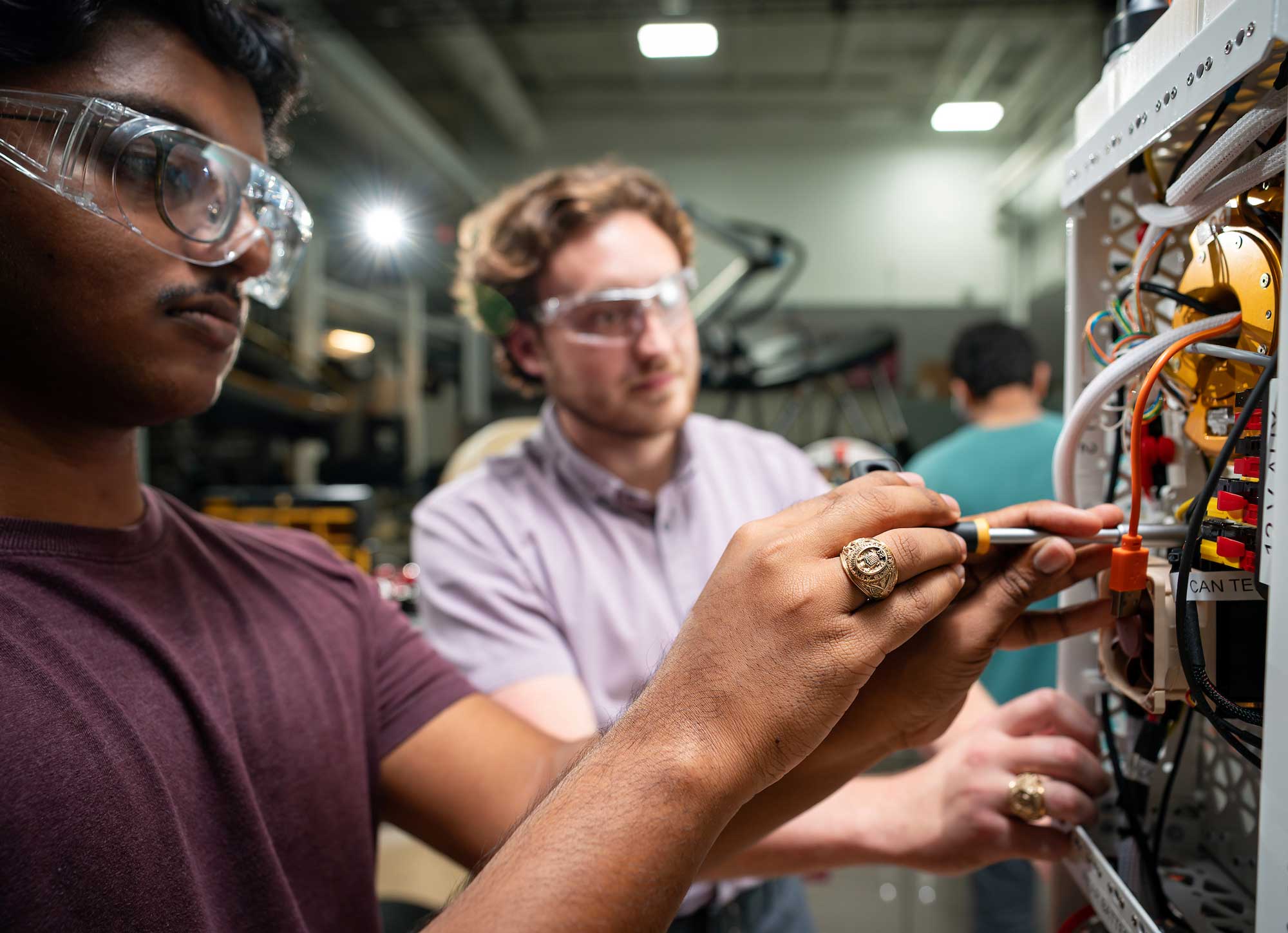
That preparation extends beyond the classroom. Through internships, research projects and hands-on learning, Texas A&M students explore their interests, gain real-world experience and develop skills that set them apart in their careers.
“We have very strong internship programs,” Bishop said. “One of the beautiful things about Texas A&M is that companies love us. They love our students, and we help them get internships all over the place — certainly in the state of Texas. The Aggie Network is amazing, and we utilize that to help our students get in their careers and get started.”

The Aggie Passport
The world doesn’t just need more graduates — it needs good citizens. Discover how Texas A&M is preparing Aggies to become a force for good on campus, in their communities and throughout their lives.
Learn more about the credentialsSavell sees internships and other experiential learning opportunities as an important part of the transformation that takes place during a student’s time at Texas A&M.
“The classroom is where the spark happens. A professor makes a subject come alive, and a student realizes there’s a whole area they didn’t know existed,” Savell said. “Then the fire gets built outside the classroom in a lab or an internship. I tell students all the time that college is like a decorated cake. The coursework is the batter, and everybody’s is about the same. The rest is yours to decorate.”
The spark that Savell described can lead students in countless directions. It may ignite a passion for fields such as engineering, medicine, agriculture or business. It may lead a student into research, public service or an entirely new industry. It may even become the inspiration a student needs to envision and create a world-changing invention.
To help sparks become flames, the university will soon roll out the Aggie Passport, which will give students academic credit for these experiential learning opportunities.
“We all know the Aggie experience is unparalleled. With the Aggie Passport, we will document that experience for the first time. The other education — the cocurricular experiences, leadership, engagement, traditions that define the Aggie experience — will be credentialed alongside our students’ official transcript,” Ballabina said.
By fulfilling the land-grant promise in its own unique way, Texas A&M transfers knowledge and creates opportunity, cultivates potential and prepares students to put what they learn into action for the greater good. That is the transformative power of a Texas A&M education rooted in the land-grant promise made 150 years ago — a promise the university will continue to honor for the next 150 years and beyond.
“Ultimately, the most important thing Texas A&M sends into the world is not a building, a ranking or a trophy; it is an Aggie,” Ballabina said.
Transformative Education
How to Apply
You may be the first in your family to attend college, or you may come from a long line of proud Aggies. Maybe you are enrolled in a Texas high school or are attending college on the other side of the world. Whatever your situation, your plans and your dreams — we invite you to apply to Texas A&M University.
Learn More
Texas A&M University has 17 colleges and schools on our main College Station campus. We also have two branch campuses located in Galveston and Qatar.
For 150 years, Texas A&M University has pioneered research innovations in agriculture, engineering, health sciences, national security and space exploration. Leveraging nationally ranked programs and extensive resources, the university is dedicated to advancing knowledge and developing impactful solutions that benefit the state of Texas and beyond.

Built to Serve: Texas A&M’s land-grant heritage and 150 years as a force for good
For a century and a half, Texas A&M has partnered with communities, industry and government to turn education, research and extension into real-world solutions for the people of Texas and beyond.
Read the Introduction-
Part Two: Education • Reading Now
The transformative power of a Texas A&M education
At the heart of the land-grant mission is the belief that higher education can transform lives by expanding opportunity, developing potential and preparing people to put what they learn to work in service to others.
-
Part Three: Research
Beyond discovery: Research with purpose thrives at Texas A&M
As a land-grant university, Texas A&M conducts research driven by public need and a sense of service, uniting inquiry and expertise to turn knowledge into solutions that make a real difference in the real world.
-
Part Four: Extension • Coming Soon
When knowledge becomes action: The impact of extension at Texas A&M
Through extension, Texas A&M turns innovation into tangible impacts, fulfilling its promise to serve Texas, the nation and beyond.