Using Math To Turn Music Into Art
A Texas A&M professor has found an unexpected way to turn music into art by using mathematical algorithms.
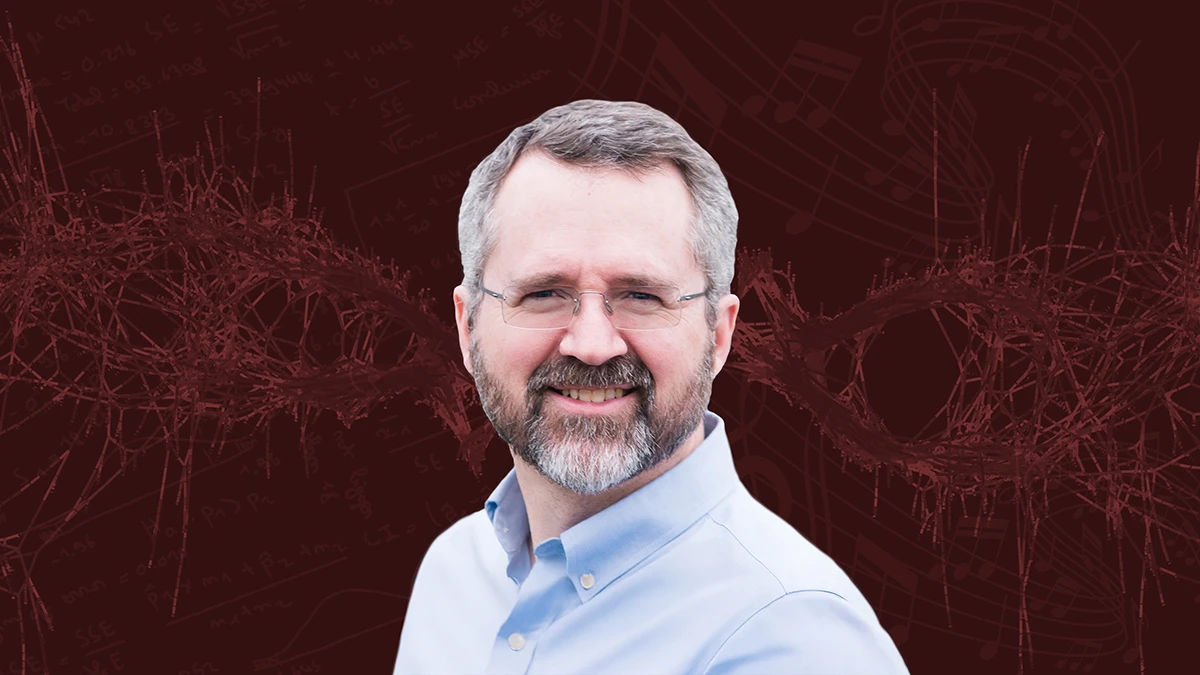
At Texas A&M University, anything is possible — even creating art from music using mathematical algorithms. Just ask Dr. Timothy A. Davis, a professor in the College of Engineering’s Department of Computer Science and Engineering, who is using sparse matrices to transform music into beautiful art.
Davis starts by converting an entire piece of music into a sparse matrix. He then selects the parameters for the algorithm that he uses to draw the matrix, choosing the math based on the art he wants to create. His approach relies on Fourier transforms, graph theory, sparse matrix methods and force-directed graph visualization. He generates thousands of images of each piece of music and selects the ones he feels best represent that piece.
His creations reflect the transformative power of interdisciplinary thinking and produce art that reveals unexpected connections, like a Celtic hymn visualized as a Celtic Trinity Knot. Through his work, Davis not only advances his field but also inspires others to see the world, and even its data, differently.