Leading with character, for Earth and space
Recognized for helping shape and equip principled leaders, Texas A&M University welcomes inaugural cohort of U.S. Space Force service members selected to participate in four-week course.
Our daily lives revolve around points of connectivity fueled by technology. From the ability to communicate around the globe to using GPS in our cars and on our handheld devices, our day-to-day capabilities are defined by space.
Beyond the conveniences we’ve grown accustomed to, space is home to a vast network that requires distinct attention and demands the best from those recruited to protect it as the ultimate high ground. This is where Texas A&M University stands to serve, building a brighter, safer world by helping to shape and equip principled leaders deeply committed to keeping space secure, stable and accessible for protecting our nation and fostering innovation.
In January, 24 mid-level officers (known as Guardians) from the U.S. Space Force will be welcomed to Texas A&M’s main campus at The Bush School of Government and Public Service as they embark on a four-week Captain’s Leadership Course offered in partnership with STARCOM, the Space Force’s Space Training and Readiness Command. As the first cohort of participants selected to complete the course focused on leadership, these service members bring military experience coupled with highly technical expertise in space launches, orbital mechanics, space intelligence, acquisition and cyber.
When the Space Force looked across the entire country for a university partner to help develop its officers as leaders, they chose Texas A&M.
“The Captain’s Leadership Course will help officers hone their leadership skills to make bigger impacts as advocates for space capabilities, warfighters within the space domain and professionals in the national security arena,” said Col. (Ret.) Kevin Parker, director of the National Security Leadership Program at The Bush School. “When the Space Force looked across the entire country for a university partner to help develop its officers as leaders, they chose Texas A&M.”
Supported by a $1.8 million grant contract from the U.S. Department of War, STARCOM’s instructors will be embedded in The Bush School, teaching alongside faculty members who are seasoned practitioners in areas like the military and intelligence community. Students will receive classes on space readiness and multi-service integration taught by Space Force instructors. Texas A&M’s faculty will provide instruction on courses in leadership and communication in partnership with the Hollingsworth Center for Ethical Leadership in the Corps of Cadets.
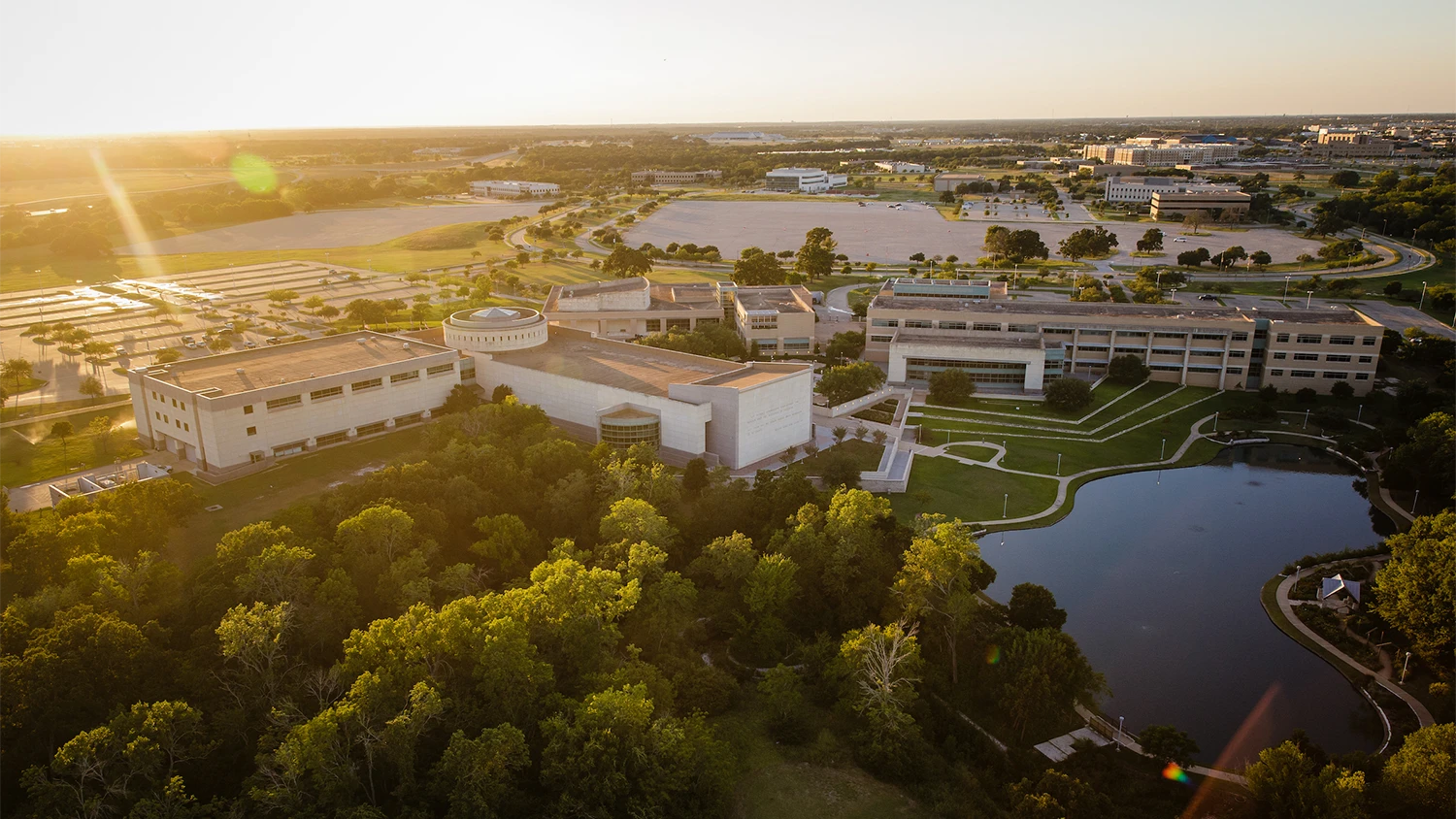
Founded under President George H.W. Bush’s philosophy that “public service is a noble calling,” The Bush School of Government and Public Service reflects that notion through curriculum, research and the student experience.
Thoughtfully structured, this opportunity to support the Space Force serves an important role in enhancing the student experience and allowing current students to be alongside some of our nation’s most trusted service members. Texas A&M is working alongside U.S. Space Force Delta 13, based out of Joint Base Andrews, Maryland, which leads the course for STARCOM, headquartered at Patrick Space Force Base, Florida.
“As someone who worked closely with the Space Force and other aspects of national security space missions throughout my career, I’m honored that the Space Force has chosen Texas A&M as the location to ready their next generation of leaders,” said John Sherman ’92, dean of The Bush School. “This is what we do at The Bush School and Texas A&M, where our proven track record of leadership and public service education will help prepare the Guardians for their mission of keeping our nation’s ultimate high ground secured.”
With growing workforce needs in aerospace, Texas A&M is uniquely positioned to introduce students to the career opportunities available and serve an integral role in an industry deeply tied to the state’s economy. Incorporating the Captain’s Leadership Course into the campus community’s network of activity offers an additional touchpoint for students to learn from the experiences of these seasoned military personnel also embarking on their next chapter. The university has a long history of space research, with over 280 faculty and investigators — including eight astronauts — currently involved in space-related projects, and 12 schools and colleges taking part in space research. Texas A&M is also a leader in aerospace engineering, with its undergraduate program ranking 8th among public institutions and its graduate program ranking 6th. The university continues to meet the needs of the U.S. workforce and the nation’s demand for highly skilled professionals in critical industries like space exploration and semiconductor technology with the launch of two new graduate degrees: a Master of Engineering in space engineering and a Master of Science in microelectronics and semiconductors.

The Hollingsworth Center for Ethical Leadership serves as the leadership and character “Center of Excellence” supported through the Texas A&M Corps of Cadets. Undergraduate students formally study leadership concepts with the intentional application and practice of ethical leadership principles.
The Texas Economic Development Corporation offers context to the importance of preparing this next generation of thought leaders in these disciplines. The state’s aerospace and aviation industry directly employs more than 148,000 workers across more than 1,400 business, and Texas A&M’s programs are positioned to supply this growing sector with a highly skilled workforce. With 16 of the 19 Fortune 1000 and all eight of the Fortune 500 aerospace and defense companies operating in the state, including Lockheed Martin, Raytheon and Boeing, Texas continues to be a powerhouse in space-related research and manufacturing activities.
Even beyond the natural fit with the mission of Texas A&M and the founding principles carried through the Aggie Core Values, the Space Force uniquely has ties to Aggieland. Gen. Bernard Schriever ’31 exemplified the Aggie ingenuity, leadership and service that helped propel the university into the national spotlight as a leader in engineering and space research. After graduating from Texas A&M in 1931 with a degree in architectural engineering, Schriever joined the U.S. Army, where he became a test pilot. He served his country during World War II in the U.S. Army Air Corps and transitioned to the U.S. Air Force when it was created in 1947. Thanks to his engineering background, he later became a pivotal architect of America’s ballistic missile and military space program and is often called the “father of the Air Force’s space and missile program.” He oversaw the early days of the American space program and applications like satellite photo reconnaissance, communication, nuclear surveillance, early missile launch warning and weather satellites.
Schriever was an early pioneer in space engineering, and Texas A&M — a triple grant designated land-, sea- and space-grant institution — is continuing to build its reputation in that expanding field with the creation of the Texas A&M Space Institute. The institute, located next to NASA’s Johnson Space Center in Houston, will provide researchers with the resources they need to send humans to explore beyond the lower Earth orbit, back to the moon and finally, on to Mars. Not only will this institute push humanity forward in the exploration of the universe, but it will also help establish Texas A&M’s place as the top space university in the world.
“As a land-, sea- and space-grant institution with a long history of answering our nation’s call, Texas A&M University is honored to support the Space Force in preparing the next generation of leaders for the challenges ahead,” said Tommy Williams ’78, interim president of Texas A&M. “Welcoming these officers to Aggieland strengthens our commitment to national service and creates meaningful opportunities for our students to learn from individuals who have dedicated their lives to protecting our country. This collaboration reflects the very best of Texas A&M — bringing together education, leadership and service to meet the needs of our state and nation.”
Through the Captain’s Leadership Course, Texas A&M continues its legacy of preparing principled, skilled leaders for future challenges in space and technology and demonstrates a commitment in fostering connectivity, mentorship and knowledge exchange about space security and technological innovation through the lens of public service.