Texas A&M Launches Clinical Trial To Measure Health Benefits Of ‘Agrihood’ Living
Researchers will track how living in an agrihood — a neighborhood centered around a working farm — changes residents’ diet, physical activity and social connectedness.
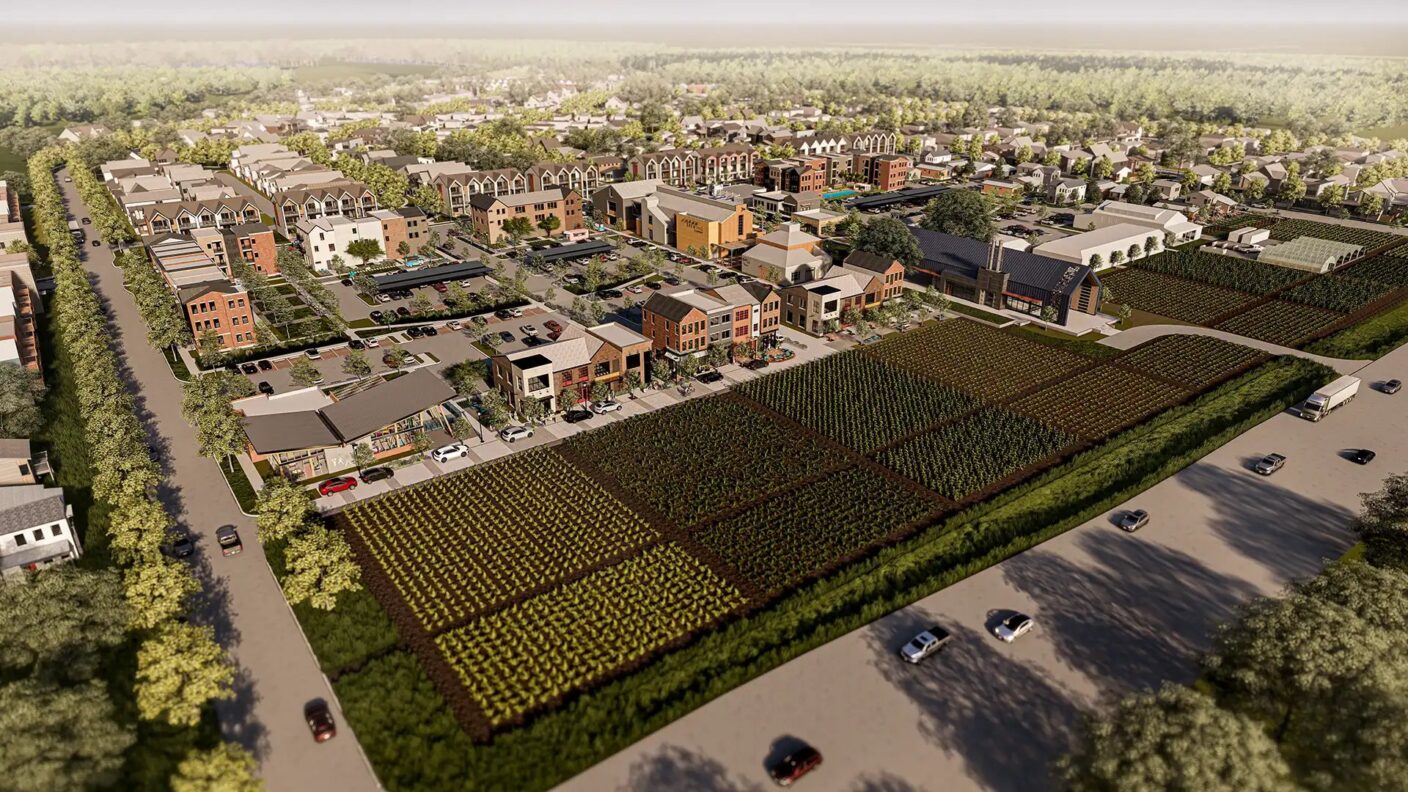
Residents of the Indigo agrihood will live alongside a working farm.
Could moving into a neighborhood built around a working farm be the prescription for better health? A new Texas A&M University and Texas A&M AgriLife Research study is putting that question to the test, tracking how residents of a new “agrihood” community change their diet, exercise, and overall health after moving in.
The prospective study, led by Jay Maddock, a professor in the School of Public Health and director of the Center for Health and Nature, will follow a cohort of residents of a newly-developed “agrihood” — a master-planned residential development built around a working farm — to track how living in an agriculturally-integrated community may support healthy living.
At the center of the study is Indigo, a 235-acre master-planned community in Fort Bend County where residents will begin to move later this month. The neighborhood will have 42 acres dedicated to agriculture, including crop fields and a livestock pasture. Plans also emphasize walkability, with more than half of the land dedicated to car-free green spaces.
Maddock, whose research includes topics such as how exposure to parks and green spaces benefits mental health at the neighborhood level and how hospital rooms designed with natural elements aid the recovery process, said the new Indigo development presents a unique opportunity to gather data on residents both before and after they move to an agrihood.
“The developers pretty much took everything that we’ve known about what makes a healthy community and tried to build it into this community,” Maddock said. “That’s what makes this so exciting — it lets us see how people live before they move in and after they move in: does that actually change their behavior?”
Behavioral change is one of the fastest transitions into healthier living, which is exactly the kind of work underway at the Institute for Advancing Health through Agriculture (IHA), part of Texas A&M AgriLife Research. The study is co-led by Dr. Lexi MacMillan Uribe, a professor in the Department of Nutrition and faculty scientist at IHA, which is the world’s first research institute to combine precision nutrition, responsive agriculture and behavioral research to reduce diet-related chronic disease in a way that considers environmental and economic effects to improve human health.
“Healthy living is one of the IHA’s three strategic research focuses,” said MacMillan Uribe, who is also a registered dietician nutritionist. “By rigorously tracking nutritional intake, activity and community cohesion before and after moving into the Indigo agrihood, this study provides actionable evidence on how agriculture centered environments can foster better health outcomes.”
A farm or garden is typically the hub of an agrihood, which are also designed with shared green spaces, water features, walking trails and community centers. With about 100 of such communities planned or in development globally, Maddock said agrihoods are still a relatively new concept, and there’s almost no scientific literature that explores their health benefits.
The 13-month study, also operating under the co-leadership of Dr. Renee Umstattd Meyer from Baylor University and a large cross-disciplinary team of co-investigators, will recruit 350 participants total. Participants will be comprised of 175 Indigo residents and 175 residents of a comparison community in Fort Bend County. Located about 20 miles away from Indigo, the comparison neighborhood has similar demographics but is a traditional planned community without the features of an agrihood. Participants will complete a comprehensive survey about their lifestyle before moving in to establish a baseline and will be surveyed again at three and six months.
“Our biggest thing we’re looking at is changes in physical activity and nutrition,” Maddock said. “In terms of biomarkers, we’re looking at blood pressure, cholesterol, and the other metabolic health indicators.”
One of IHA’s mobile health assessment clinics will be brought to both neighborhoods so researchers can measure residents’ height, weight, blood pressure and other data points. Maddock said they’ll use a “Veggie Meter” device — which non-invasively takes a scan of a person’s finger — to estimate fruit and vegetable consumption based on carotenoid levels in the skin, and physical activity will be monitored by accelerometers worn by participants.
Maddock said the Indigo participants he’s spoken to have told him they chose to buy homes in the neighborhood for the opportunity to live near a working farm. Social connectedness is another outcome that will be monitored. “It does seem that people will connect more to each other and connect to the farm and where their food comes, but so far it’s all been anecdotal evidence,” he said. “This is a first-of-its kind exploration of this.”
Maddock said he sees promise in agrihoods as a model for urban development.
“Forty percent of Americans have never met a farmer before in their lives. I think we’ve totally divorced ourselves from where our food comes from,” Maddock said. “I think the agrihood provides a model in a rapidly growing urban community of bringing the farmer back to the people and knowing where your food source is and how we can actually create neighborhoods that improve people’s health.”
The study will also include focus groups with residents to better understand which features of the community they do and don’t use, which could help with the development of future agrihoods.
“How integrated do people get into the farming?” Maddock said. “Are they eating the fruits and vegetables that are coming out of there? Can we get more urban animals in there, since a lot of communities ban chickens? How do we do this, and how do we do this in a way that’s sensible?”
The study is supported by the Texas A&M AgriLife Institute for Advancing Health Through Agriculture (IHA) and the U.S. Department of Agriculture, Agricultural Research Service ARS agreement number, 58-3091-1-018.