Some leaders set out to change the world. Others find themselves called to serve it.
Dr. Robert Gates never planned a life in public service — but over five decades of steadfast leadership, he became one of America’s most trusted voices and one of Aggieland’s most enduring heroes.
“When I graduated from college, I certainly didn’t have in mind a career in public service,” Gates recalled. “But when I got my master’s degree at Indiana University in Russian and Eastern European studies, I had two job choices: one was to teach seventh-grade history in Williamsburg, Virginia, and the other was CIA.”
He chose the CIA but figured he would still circle back around to teaching one day.
“My aspiration was actually to teach in college, and so I told myself, well, I’ll do the CIA thing for a little while, and then I’ll go teach. When I completed my Ph.D. at Georgetown in 1974, just as I was sending out applications and letters of inquiry about teaching positions, I received an invitation from National Security Advisor Henry Kissinger to join the NSC staff at the White House, where I was assigned to the Soviet desk. And I told my wife, I’ll do that for a couple of years, and then I’ll go teach.
“Well, I never got to teach.”
Path to Aggieland
It was George H.W. Bush who first introduced Gates to Texas A&M back in 1999. “I had never lived in Texas, gone to school in Texas or anything else. And, so I get a call in the spring of 1999 from former President Bush, and he says, ‘I’ve got this school…’”
And the rest is Texas A&M history.
Bush convinced Gates to come to Texas and take on the role of interim dean of The Bush School of Government and Public Service. “I showed up on the A&M campus in August of 1999, and because there were no quarters for me or anything, and because I was there off and on, I actually ended up spending about two weeks a month there and spent the entire first year living out of one of the regents’ rooms in the MSC.”
He would box up his belongings each time there was a regents meeting or football game when regents needed the quarters. While the initial transient life may not seem ideal, it gave Gates time to really get to know the main campus and the heart of the university — the students.


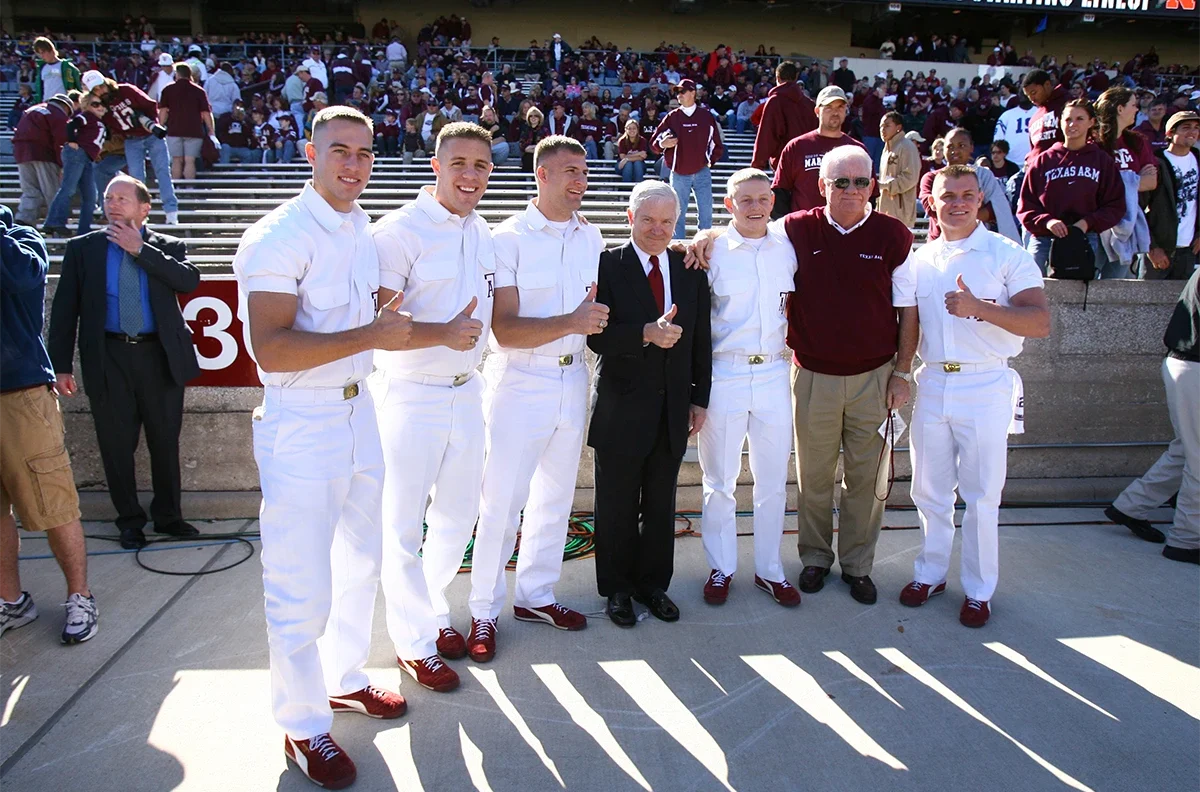

Photos by the Division of Marketing and Communications
“I stayed in the MSC for the first year I was dean, but there I was in the heart of campus, and the result was the birth of a love affair that has never ended. Being around the students and in the middle of the campus, I just fell in love with the place,” Gates said.
“There was a spirit that I had never seen anywhere else. The kids were so nice and everybody was so welcoming.”
He was wrapping up his time as interim dean when the chairman of the Texas A&M University System Board of Regents asked him if he would consider being a candidate for president of the university. Gates quickly replied, “Not a chance.”
He was asked again in December 2001. “They asked the same question, and I talked to my wife, and I said, I feel like after 9/11, I have to do one more public service, but I definitely don’t want to go back to Washington, D.C. So how about it? How about we do this? And that’s how I became a candidate for president, and then president of Texas A&M.”
Leaving his mark on Texas A&M
Gates officially became the 22nd president of Texas A&M in 2002. Today, nearly 20 years after leaving the university president’s office, Gates’ impact can still be seen and felt on Texas A&M’s main campus.
Many Aggies may not know that it was Gates who championed putting into words the Core Values that the university was built upon: Excellence, Integrity, Leadership, Loyalty, Respect and Selfless Service. These have always been values that every Aggie holds dear, although not officially put into words. Today, they guide the university and those who love it, echoing Texas A&M’s purpose statement, which is to develop leaders of character dedicated to serving the greater good.


Photos by the Division of Marketing and Communications
Another more visible result of Gates’ tenure as president is the restoration of Military Walk, which had been in decline for decades. It was on one of his daily walks around campus that Gates decided something needed to be done.
He told the Texas A&M Foundation, “Generally, on Friday and Saturday nights, I would go for a cigar walk around campus,” he said. “One night while walking, I realized that most of the trees that have lined Military Walk were still there, but it had just become another sidewalk.”
He decided that wasn’t acceptable and pushed for a renovation plan. The restoration of Military Walk exemplified Gates’ leadership style as president — finding ways to honor the past while moving forward.
“One of the things I tried to do in leading change at Texas A&M to position it for the future was to make sure that we emphasized and preserved the traditions that made us great in the first place.
“It was behind my initiative to restore Military Walk. It was behind the initiative to make the values — the values that are celebrated on campus — core to A&M culture. I wanted to have those roots firmly planted in the past so we didn’t forget who we were and how far we had come,” he said.
The revitalization of Military Walk may be one of the most visible markers of his presidency, but his impact was felt in other ways, such as adding 440 faculty positions, launching a $300 million campus construction program and boosting funding to elevate Texas A&M’s national standing.
During his tenure as president, Gates came to love the campus and its traditions, in particular, Muster. “There is nothing like it in any other institution in America, not in the military services, not in corporate America, not in any other university, for sure,” Gates said. He points to the connectedness of the Aggie Family coming together to grieve their own. “We’re all part of one family, and the opportunity to come together and recognize those who have passed in the past year is huge.”

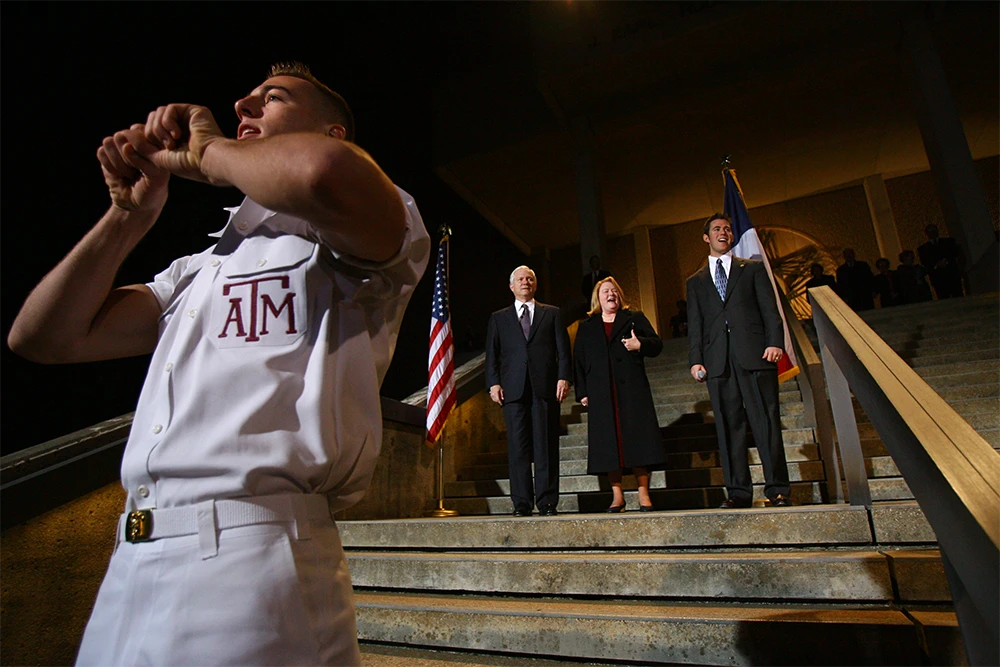


Photos by the Division of Marketing and Communications
A lifetime of achievement
Gates served under eight presidents — including George H.W. Bush, George W. Bush and Barack Obama — during his distinguished and nearly 27-year career as an intelligence professional, first joining the CIA in 1966. He was the first career officer in the CIA’s history to rise from entry-level employee to director. He served as director of central intelligence from 1991-93 and, through the collapse of the Soviet Union, restructured the intelligence community for a post-Cold War world.
He served as secretary of defense from 2006-11 and is the only one in U.S. history to be asked to remain in that office by a newly elected president — Barack Obama. As secretary of defense, Gates reversed losing wars in Iraq and Afghanistan while preparing the U.S. military for unconventional warfare and dramatic reductions in federal spending. Gates is fondly remembered as the “soldiers’ secretary.”
On his last day in office, Obama awarded him the Presidential Medal of Freedom, America’s highest civilian honor. He has also received the National Security Medal, the Presidential Citizens Medal, the National Intelligence Distinguished Service Medal and the CIA’s highest award, the Distinguished Intelligence Medal, three times.